

Best Ways to Save Money in 2026: What Actually Worked for Me
May 8, 2026
How I Finally Stopped Throwing Money Away at the Pump
May 10, 2026
TL;DR
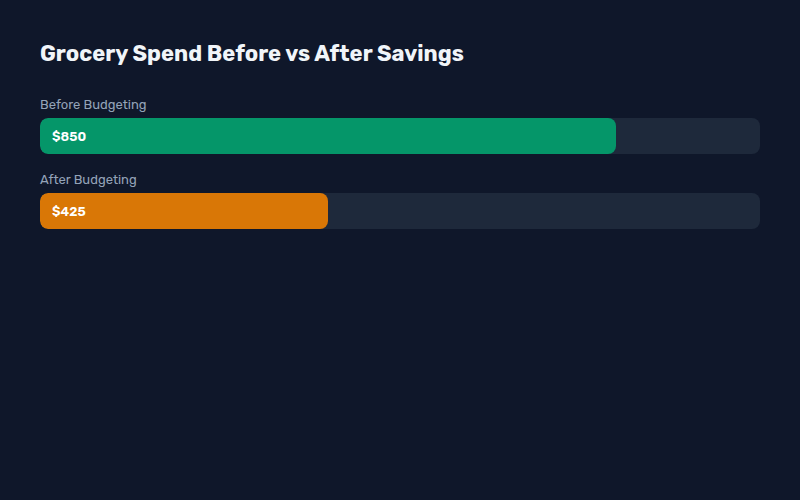
- I was spending $850/month on groceries for two people — embarrassing for someone who writes about saving money
- After a brutal reality check, I cut it to $425/month using meal planning, store switching, and cooking from scratch
- No extreme couponing, no dumpster diving — just simple habits that anyone can steal
I stared at my credit card statement like it was written in a language I didn’t understand. $847.62. That’s what my wife and I spent on groceries in March 2025. For two people. In a mid-sized Midwest city where the cost of living is supposed to be reasonable.
Here’s the thing — I write about saving money for a living. I’ve published articles about budgeting, frugal living, and cutting expenses. But apparently, I wasn’t practicing what I preached. My grocery spending was out of control, and I didn’t even realize it until I forced myself to look at 12 months of bank statements.
The Numbers That Made Me Cringe
When I finally added everything up, the picture was ugly. From April 2024 to March 2025, our average monthly grocery spend was $847. That’s over $10,000 a year on food we cooked at home — not counting the $300+ we were blowing on takeout every month. I nearly choked on my overpriced avocado.
The worst part? We weren’t buying fancy stuff. No organic this, grass-fed that. We were just buying badly — lots of convenience foods, brand-name everything, and things that expired before we used them.
I knew something had to change. Not because we couldn’t afford it, but because the waste was embarrassing. We were throwing away about $120 worth of food every month — vegetables that wilted, leftovers we forgot, bulk buys that seemed smart at Costco but never got eaten.
The Meal Planning System That Saved Us $200 in the First Month
I tried meal planning before and hated it. The Pinterest-style plans with color-coded spreadsheets and elaborate Sunday prep sessions? Not for me. So I built a stupid-simple system that actually stuck.
Every Saturday morning, I spend 10 minutes doing three things: checking what’s already in the fridge and pantry, picking 5 dinners from a rotating list of 20 meals we actually like, and writing the grocery list on a magnetic pad stuck to the fridge. That’s it. No apps, no spreadsheets, no influencers telling me to batch-cook 30 meals in one afternoon.
The result? Our first month on this system, we spent $612 on groceries. The second month, $524. By month three, we hit $398 — less than half of what we were spending before. The key wasn’t more planning. It was the right amount of planning for our actual lifestyle.
Why Aldi and Store Brands Changed Everything
I used to think I was too good for Aldi. The quarter for the cart, the bagging-your-own-groceries thing, the random brands with names like “Baker’s Corner” and “Mama Cozzi’s” — it felt like a downgrade. But after that $847 shocker, I finally walked into one.

The savings were immediate and ridiculous. A gallon of milk that costs $4.29 at Kroger was $2.95 at Aldi. A dozen eggs went from $3.49 to $1.89. My usual $120 weekly haul cost $78 at Aldi — a 35% discount just by switching stores. The catch was learning which items were worth buying at Aldi and which ones I still needed to get elsewhere. Their produce is hit-or-miss, and their meat selection is limited. So I developed a two-store strategy: Aldi for dry goods, dairy, and pantry staples (60% of our groceries), and a regular supermarket for fresh produce and specific brands (40%).
I also stopped buying brand names out of habit. Store-brand canned tomatoes taste exactly the same as Hunt’s. Store-brand shredded cheese melts the same way Kraft does. The only things I still splurge on are coffee (I’m a snob, I admit it) and certain condiments. Everything else is generic now, and nobody in my house has noticed. That alone saves us about $60 a month.
Cooking From Scratch — It’s Not as Hard as You Think
I’m not a good cook. I burned rice three times in one month. But I learned that “cooking from scratch” doesn’t mean making everything from zero. It means skipping the middleman.
A box of Hamburger Helper costs about $2.50 and feeds two people. But the ingredients inside are basically pasta, powdered milk, and seasoning. Making the same thing from scratch costs about $0.80 and takes maybe 5 extra minutes. Multiply that by 20 meals a month, and you’re looking at real savings.
I started with simple swaps: making my own salad dressing ($0.50 vs $4.00 a bottle), roasting my own chicken instead of buying rotisserie ($2.50 vs $7.00), and making big batches of rice and beans as a base for multiple meals. Within two months, I had about 15 “rotation recipes” I could make without thinking — meals that cost under $5 for both of us.

The biggest saver was dried beans. A pound of dried black beans costs $1.50 and makes the equivalent of about three cans. That’s a 70% savings. I now cook a big pot of beans every Sunday and use them throughout the week in tacos, soups, burrito bowls, and salads. It sounds boring, but with the right seasonings, it’s actually delicious.
The Waste Audit That Hurt but Helped
For one month, I kept a “waste log” — a simple notebook by the trash can where I wrote down every food item I threw away. It was humiliating.
Week one: half a bag of spinach ($3), a carton of sour cream that expired two weeks ago ($4), some ground beef I forgot in the back of the fridge ($6), and a bag of apples that went soft ($5). That’s $18 in one week. Week two was worse — I threw away a whole rotisserie chicken I’d bought with good intentions but never used ($7), along with more produce and a half-eaten tub of hummus.
By the end of the month, I’d counted $127 worth of wasted food. That’s $1,524 a year. Just gone. The audit changed my buying habits permanently. Now I only buy produce for the next 3-4 days, not the next two weeks. I keep a “eat this first” shelf in the fridge for things about to go bad. And I freeze anything I’m not going to use within 48 hours. Waste is down to about $25 a month now.
The Monthly Reality Check That Keeps Us Honest
Every month, I still look at our grocery spending. I don’t obsess over it — that would be exhausting — but I check. The first of each month, I pull up the bank app and look at the “Groceries” category total from the previous month. It takes 30 seconds.
When I see the number creeping up, I know exactly why. Maybe I got lazy with meal planning. Maybe we took a “treat yourself” trip to Whole Foods that turned into a $200 disaster. The awareness alone is enough to course-correct. We’ve been below $450 for six straight months now, and the habits have become automatic. I don’t even think about most of them anymore.

Look, I’m not going to tell you that cutting your grocery bill in half is easy. The first month sucks. You have to break habits you’ve had for years. You’ll forget the meal plan and order pizza more than once. But if you can stick with it for 30 days, the savings become addictive. $400 a month stays in your pocket. That’s $4,800 a year. For me, that’s a vacation. For you, maybe it’s a car payment, a student loan, or just breathing room.
Start with one change. Switch to store brands for one week. Do a waste audit. Try Aldi if you haven’t. You don’t need to overhaul everything at once — just one habit that sticks is worth more than a perfect plan you abandon after two weeks.
— Rand, meetelesh.com Daily Savings