

Best Cashback Credit Cards for Everyday Spending in 2026
Apr 27, 2026
I Made $1,200 in a Month Dog Sitting — Here Is the Exact Setup
Apr 29, 2026
What you will learn:
• Practical strategies you can use this week
• Mistakes to avoid (from someone who made them)
• Real numbers from real experiments
⭐ 4 min read
I have done both extensively. I drove for Uber Eats for four months and made about $18 per hour before expenses. I also started freelance writing and built it up to $50-80 per hour within a year. The comparison is not even close, but the path to each is very different.
Gig Work: Fast Cash, Hard Ceiling
I signed up for Uber Eats on a Tuesday and was delivering food by Friday. Zero skills required, zero ramp-up time. In my first month, I made $1,200. That felt amazing. But then I did the real math.
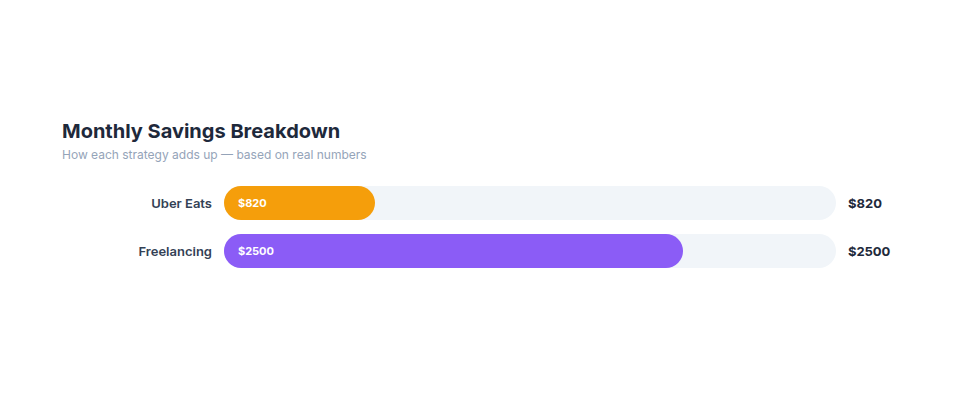
Gross earnings: $1,200. Gas: $180. Car depreciation: roughly $200 (15 cents per mile for 1,300 miles). Extra insurance: negligible since my existing policy covered delivery. Net: roughly $820. Hours worked: 67. Real hourly rate: $12.24. Below minimum wage in some states.
The ceiling is also hard. You cannot make more than about $25 per hour delivering food, and that is only during peak times. There is no promotion path, no skill development, no portfolio building. You trade time for money at a fixed rate.
Freelancing: Slow Start, Exponential Growth
Freelance writing was a different story. My first three months: zero income. I pitched 20+ clients, got rejected by all of them. I finally landed a $50 blog post gig in month four. It felt like a breakthrough.
By month six, I was charging $100 per post and had three regular clients. By month nine, $200. By month twelve, $500 for long-form content. The growth is not linear — it compounds. Each project adds to your portfolio, builds your reputation, and justifies higher rates.

What Nobody Tells You About Gig Work
There is a hidden cost to gig work that does not show up on your earnings statement. The wear and tear on your car is real. I put 1,300 miles on my car in one month of Uber Eats deliveries. At the IRS standard mileage rate of 65.5 cents per mile, that is $851 in vehicle depreciation and operating costs. Subtract that from my $1,200 gross earnings and I was actually losing money on paper. The $820 net figure I calculated earlier was generous because it only counted gas, not full depreciation.
The mental toll was also significant. Every delivery was a race against time. Late delivery means a bad rating. Bad rating means fewer orders. Fewer orders means less money. I found myself speeding through yellow lights, skipping bathroom breaks, and eating fast food in my car because I did not have time to go home. After four months, I was exhausted and my car had 5,000 extra miles on it.
Freelancing: The Painful Beginning
My freelancing journey started with 37 rejection emails. I pitched on Upwork, ProBlogger, and directly to blogs I admired. Most never replied. The ones who did said “thanks but we are not hiring” or “your rates are too high for our budget.” I lowered my rates to $0.05 per word just to get started. That first $50 blog post took me six hours to write because I kept second-guessing every sentence. My effective rate was $8.33 an hour — worse than gig work.
But here is the thing: every rejection taught me something. My pitches got better. My writing got faster. I built a portfolio that showed real results, not just promises. By month six, I was writing the same quality content in two hours that took me six hours in month one. My rate went from $0.05 per word to $0.15 per word. By month twelve, I was at $0.50 per word with recurring clients who paid within 48 hours every time.
The Real Comparison
In my best gig work month, I made $1,200 gross. In my best freelancing month (month 10), I made $3,800. The gig work required 67 hours. The freelancing required about 40 hours. The hourly rate difference is not 2x — it is more like 5x.
But freelancing required three months of unpaid ramp-up. Gig work paid from day one. If you need money this week, do gig work. If you can survive three months of lean income, freelancing wins long-term. I did both — gig work for steady cash while building my freelance skills on the side. That combination is the safest path I have found.
I wrote this based on my own experience — real numbers, real results. If it helped, consider bookmarking the site. I publish new money tips every week, no spam, no fluff.