

YNAB vs Mint: Which Budgeting App Actually Saves You Money?
Apr 30, 2026
7 Subscriptions You’re Paying For (But Never Use) — I Found $187/Month
May 4, 2026
What you will learn:
• Practical strategies you can use this week
• Mistakes to avoid (from someone who made them)
• Real numbers from real experiments
⭐ 4 min read
I have tried couponing. Really tried. I downloaded the apps, organized the folders, remembered to bring them to the store exactly once. It felt like a part-time job that paid me in $0.50-off coupons. There had to be a better way.
Turns out, there is. I cut my monthly grocery bill from $680 to $480 without clipping a single coupon. The changes were not about finding better deals. They were about changing how I thought about food shopping. Here is exactly what I did.
The Weekly Shopping Rule
This single change had the biggest impact. I used to shop every two or three days — stopping at the store on my way home from work, grabbing “a few things” that somehow cost $40 each time. Four trips a week at $40 each is $160. One trip a week at $110 is $110. The math is simple: fewer trips mean fewer impulse buys.
When you shop daily, you buy without a list. You walk in hungry, you buy things that look good, you overspend. When you shop once a week with a list, you buy exactly what you need. I started planning my weekly menu on Sunday, made one list, and bought everything in one trip. My grocery spending dropped by $50 a month immediately.
The Store Brand Rule
I made a simple rule: for anything that is not a specific brand I actually prefer, buy the store brand. Pasta, rice, canned goods, spices, milk, eggs, bread, frozen vegetables — the store brand is almost always the exact same product in a different package. The manufacturers are often identical.
I tested this. I bought store brand and name brand versions of ten common items and did blind taste tests with my roommate. Neither of us could consistently tell the difference. The store brand was consistently 25-30% cheaper. On my monthly grocery spending of $480 after other changes, that 25% savings is roughly $120 a month. Just from buying store brand.
Meal Planning Around Sales
This was the game changer. Instead of deciding what I wanted to eat and buying whatever ingredients were needed, I started looking at what was on sale and building my meals around that. Chicken on sale? That is stir fry, tacos, and grilled chicken salads for the week. Fish on sale? That is fish tacos and baked salmon. Ground beef on sale? Chili, spaghetti Bolognese, and tacos again.
This one shift saved me about $40 a month because I stopped buying full-price proteins, which are the most expensive part of any grocery trip. The grocery store’s weekly flyer became my meal planning guide. It took five minutes to scan and made a noticeable difference in my spending.
The Freezer Strategy
I started buying meat in bulk when it was on sale and freezing individual portions. A package of chicken breasts that costs $12 at regular price goes for $7 when on sale. Buying two and freezing one saves $5 right there. Do this with ground beef, pork chops, and fish, and the savings add up fast. I save roughly $30 a month this way.

The Final Numbers
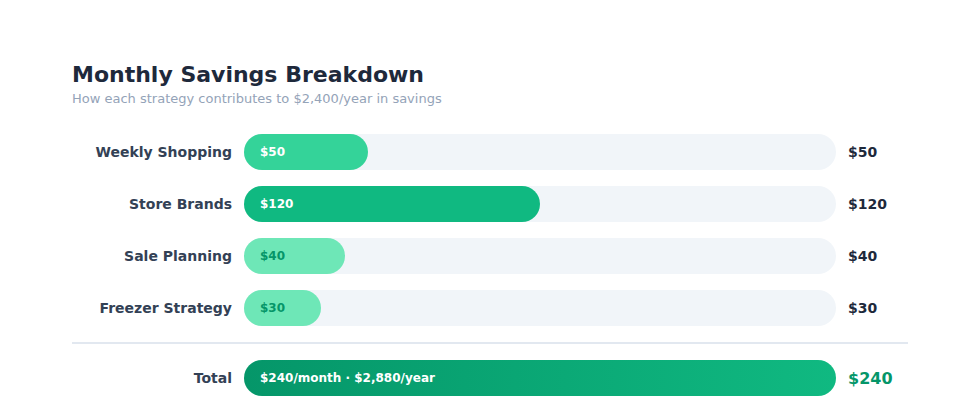
Weekly shopping: -$50/month. Store brands: -$120/month. Sale planning: -$40/month. Freezer strategy: -$30/month. Total: $240/month — that is $2,880 a year. No coupons, no apps. Just smarter habits that took a few weeks to establish.
I wrote this based on my own experience — real numbers, real results. If it helped, consider bookmarking the site. I publish new money tips every week, no spam, no fluff.